Agentic DevOps in the Autonomous Cloud
Architecting the Future of Application Modernization
InnoTech Austin 2026

Akshay Mittal, Ph.D.
Member of Technical Staff, Software Engineering · PayPal
Disclaimer: All content shared represents my personal research and professional interests. This presentation is not affiliated with or endorsed by PayPal or any other organization.
The Cognitive Overload Challenge
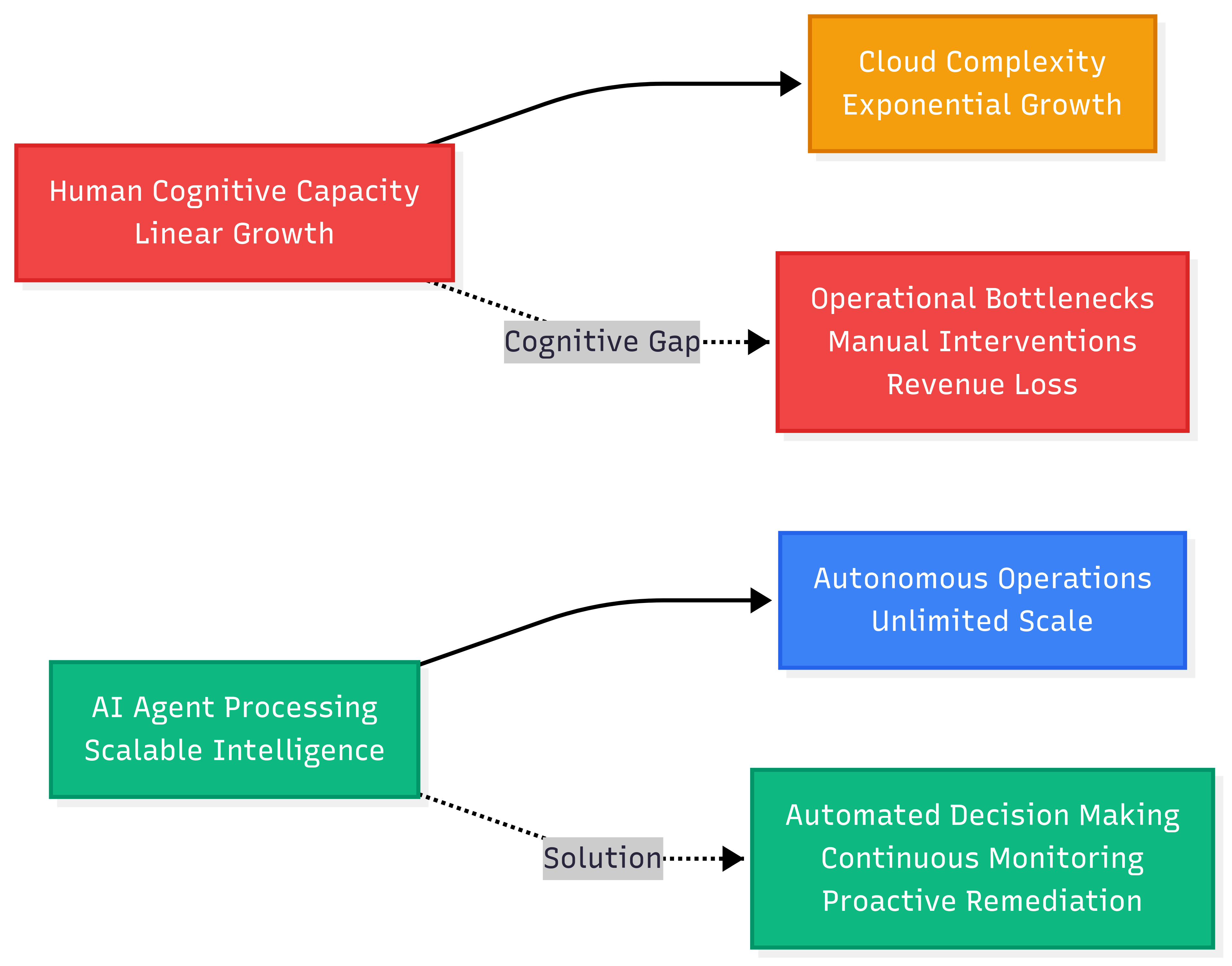
The bottleneck has moved from execution to cognition
(Cognitive load theory; e.g. Sweller; applied to DevOps)
Traditional DevOps Question:
"How do we automate repetitive tasks?"
Modern Challenge:
"How do we scale operational intelligence?"
Making context-aware decisions about deployments, incident response, and resource optimization across 1000+ microservices
Key Question:
How do we scale operational intelligence without linearly scaling our engineering teams?
The solution isn't more humans—it's AI agents that think and act autonomously
Declarative everything (2026 prerequisite)
Agents need machine-readable truth: IaC (Terraform, Pulumi), K8s manifests, policy-as-code, golden paths. You steer by desired state + guardrails, not ad-hoc scripts—otherwise autonomy has nothing solid to reconcile against.
From Read-Only to Execution-Ready AI
Traditional vs. agentic shift (Gartner, 2025) | Read-only to execution-ready adoption (McKinsey, 2025)
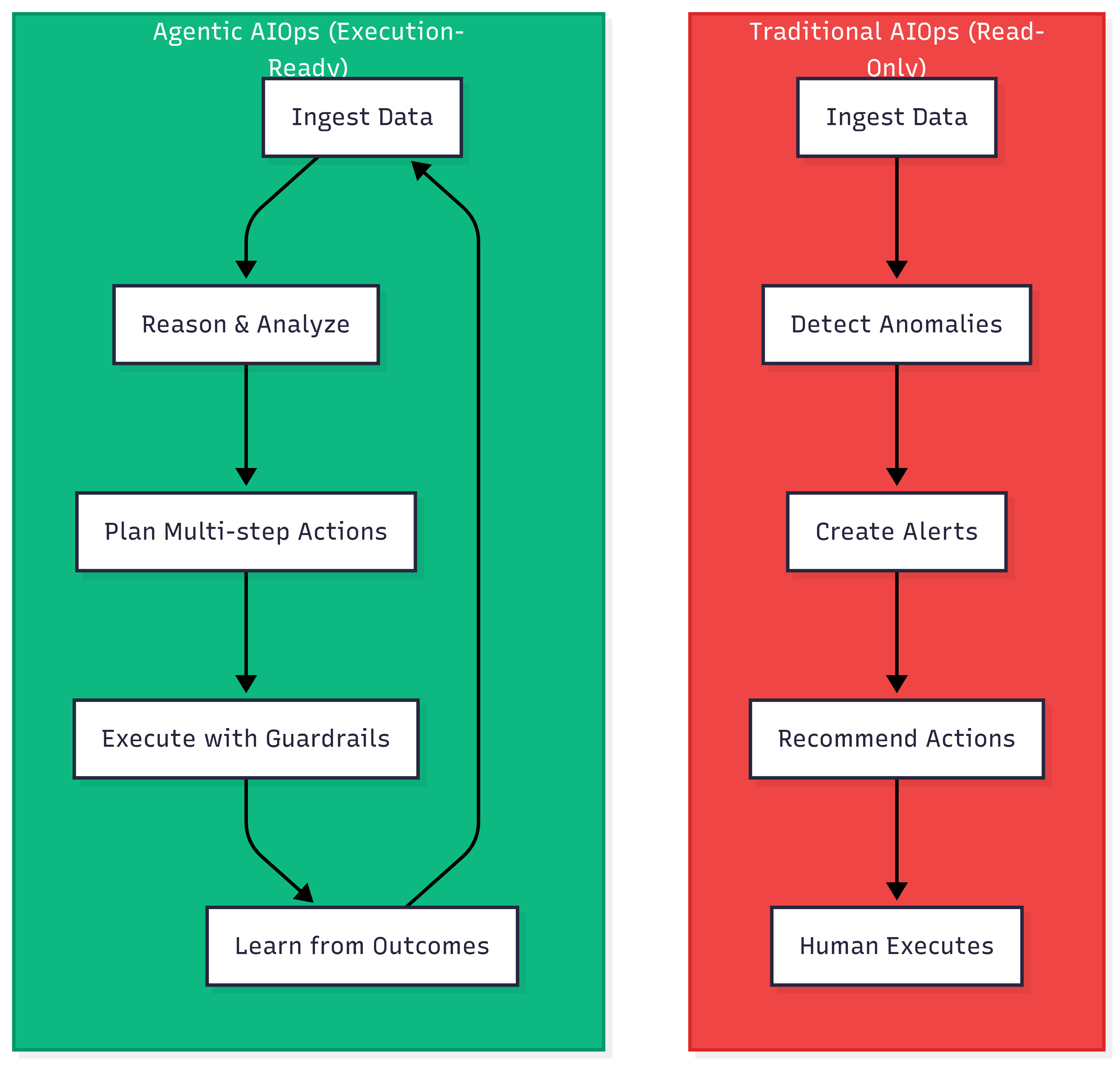
Traditional AIOps
- Ingests data →
- Detects anomalies →
- Creates alerts →
- Recommends actions
Human is the executor
Agentic AIOps
- Ingests data →
- Reasons →
- Plans →
- Executes →
- Learns
Human is the supervisor
Adoption (illustrative): surveys vary widely—treat ~50% production / ~69% human-verified agentic decisions as talking-point ranges, not audited facts (replace with your vendor’s primary survey before a board pack)
Technical Architecture: Inside an AI Operations Agent
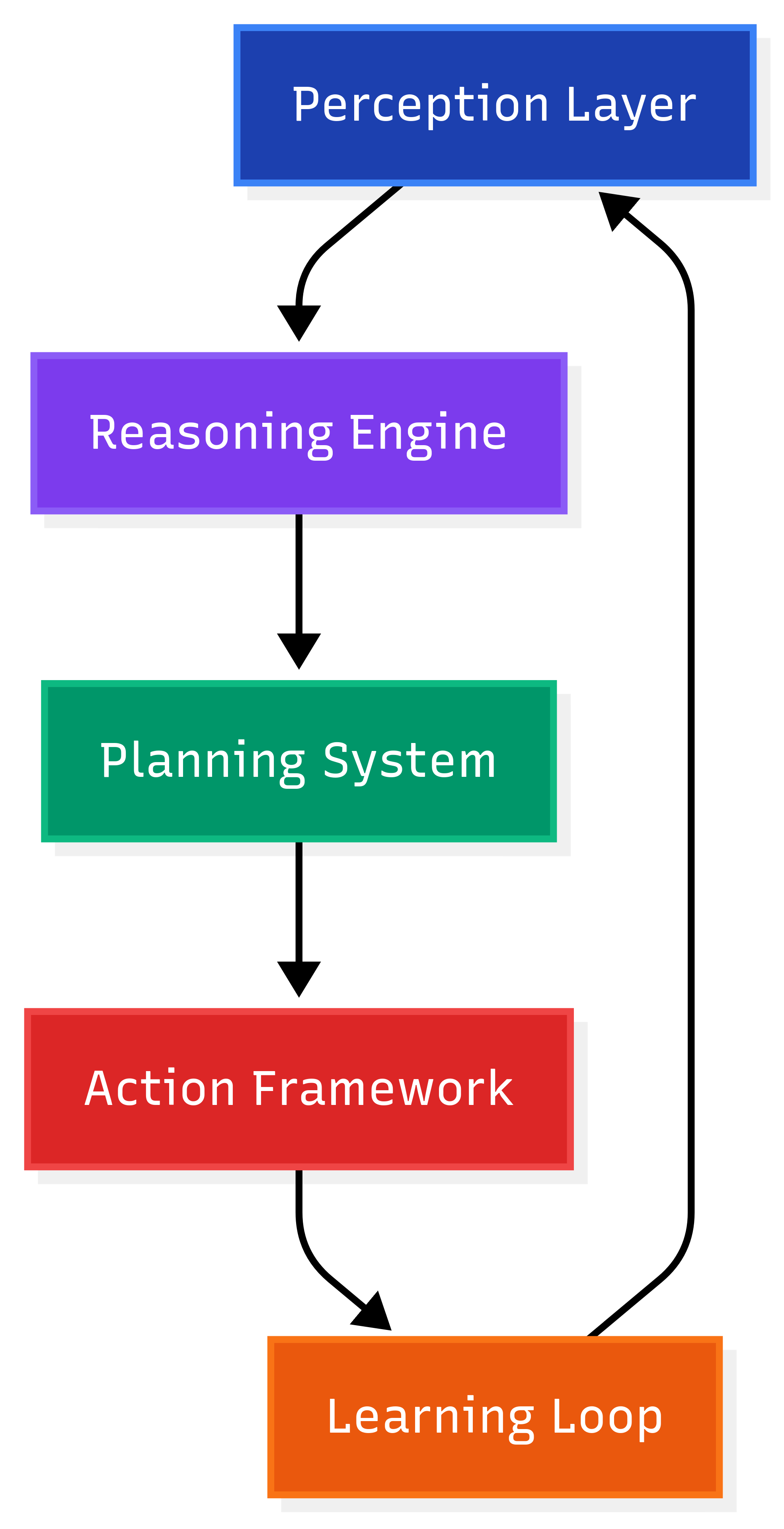
5-layer architecture enables AI to see, think, plan, act, and learn like senior SRE
(Standards: IEEE P3833 draft—proactive agent HCI framework; IEEE 3119-2025—AI procurement risk, not stack topology; plus vendor patterns)
1. Perception Layer
Signals from logs, metrics, traces, and user sentiment
2. Reasoning Engine
LLM + knowledge graph; step-by-step reasoning; doc search over runbooks
3. Planning System
Multi-step execution plans with verification and rollback
4. Action Framework
API integrations + guardrails for safe execution
5. Learning Loop
Continuous improvement from outcomes and feedback
Production Implementation:
Prometheus + OpenTelemetry | Vector databases (e.g. Pinecone/Weaviate) | Kubernetes operators | semantic search at scale (embedding counts/accuracy—deployment-specific; cite your own evals)
Real-World Implementation
Scenario: API Latency Spike Detection

- Multi-signal correlation (logs + metrics + traces)
- Root cause hypothesis generation
- Automated remediation plan creation
- Human-in-the-loop approval
- Execution and verification
Safety Metrics
Example targets: 95% accuracy | 3% false positive | 100% human approval for production changes
Traditional Approach
Manual investigation and remediation
Agentic Approach
Automated detection and remediation
Key Insight
Handle routine issues automatically, escalate complex problems to humans
Safety Protocols:
Confidence <80% → Escalate | High-risk → Approve | All → Audit trail
Quantified Business Impact
Metrics from Real Implementations
Sources: Forrester Wave DevOps Platforms Q2 2025; industry impact benchmarks · See also Forbes / Cortex — “Quality Tax” discussion (AI-accelerated dev)
The “Quality Tax” (counterweight to speed): Industry coverage cites striking figures—for example ~43% of AI-generated code still needing production debugging post-QA/staging in some analyses, alongside telemetry such as +23.5% incidents per PR and ~+30% change failure rate signals in surveyed org workflows (reporting citing Forbes contributors & Cortex, 2025–26). Use as directional risk sizing, not a promise for your KPI sheet.
Reduction in deployment lead times
Decrease in production incidents
Faster incident resolution (MTTR)
Improvement in developer productivity
Reduction in cloud infrastructure costs
Faster time to market for new features
Embedding agents into workflows (vs bolt-on): 30–50% faster processes, up to 40% reduction in low-value work (BCG research cited by Dynatrace, 2026). Industry benchmarks: 50% faster processing of operational inquiries; up to 80% toil reduction in resolution workflows where agents are used end-to-end.
CHALLENGE: Calculate potential savings for your team.
What's 80% MTTR improvement or 50% faster inquiry resolution worth to your organization?
Case Study: Thomson Reuters - GitHub Copilot at Enterprise Scale
Challenge
Developer efficiency across 10,000+ engineers
Solution
Structured 7-week Copilot pilot with 100+ senior engineers
Key Innovation
Agent-assisted code review and automated testing
46%
Faster task completion
39%
Improvement in code quality
45%
Faster PR velocity
$2.3M
Annual productivity savings
Implementation Context: 7-week pilot with 100+ engineers → scaled to 2,000+ developer seats | GitHub Analytics & surveys | 68% positive UX
Source: GitHub Universe 2025 / Thomson Reuters AI adoption (GitHub Inc., 2025)
Key Insight:
Engineers initially skeptical became strongest advocates - AI coding assistance is now mandatory for all new projects
Your 90-Day Roadmap to Agentic Operations
Assess & Govern
- Identify top 3 operational bottlenecks
- Establish AI Governance Council
- Define runtime controls: agent IDs, audit trails, human override
- Select low-risk, high-impact pilot
Team: 1 PM (.5), 2 Eng (.3), 1 Arch (.2) · Budget: $50K · Out: Governance, pilot selected
Pilot & Learn
- Deploy AI coding assistant to pilot team
- Agentic AIOps in read-only mode (default); runtime guardrails
- Train: prompt engineering, AI supervision
Team: +3 pilot (.4), 1 ML (.3) · Budget: $150K · Out: AI assistant, 80% accuracy
Automate & Expand
- Enable first execution-ready agent
- Analyze results, build business case
- Develop long-term roadmap
Team: 8 total (.3 FTE each) · Budget: $100K · Out: First autonomous action, ROI
Success Metrics: 80% MTTR reduction · 50% deployment acceleration · $2M+ annual savings · 90% team adoption
COMMITMENT CHECK: Who will start Phase 1 within 30 days? [Show of hands]
Who wants the detailed implementation checklist?
Key Takeaways
1. Autonomy is the New Automation
The industry is moving from "read-only" recommendations to "execution-ready" AI agents
2. Govern Before You Automate
Governance includes runtime controls (agent IDs, audit trails, human override), not just policy. Trust and accountability are prerequisites.
3. Platform Engineering is the Governance Layer
Agents are the engine; the IDP defines the Golden Paths agents are allowed to walk—making autonomy scalable and governed
4. The Cloud Providers are All-In
AWS, Azure, and GCP are building their futures around agentic AI
5. Start Now
- Audit your current operational bottlenecks this week
- Establish AI governance council within 30 days
- Select pilot use case by month-end
6. Safety + Agentic QE
Autonomous doesn't mean unsupervised. Runtime guardrails, human-in-the-loop, and a kill switch are non-negotiable. Pair speed with agentic quality engineering (risk-aware test direction, NL→tests) so AI-generated change doesn’t outrun verification. Start pilots in read-only mode; enable write only after guardrails and audit trails are in place.
7. The Multi-Agent Future
By 2026, specialized agents collaborate: Code-Gen → Security-Scan → Deploy → Monitor. Ecosystems already combine AWS Kiro, GitHub Copilot, ServiceNow Assist, Azure SRE Agent. Start building now.
Nature Machine Intelligence (2025) · trade press on multi-agent roadmaps · Dynatrace/BCG on embedded agents—cite specific URLs before filing.Thank You
The future of DevOps is autonomous.
Your competitive advantage depends on how quickly you start.
Let's Connect
Scan QR code to connect on LinkedIn
Disclaimer: Personal research and professional interests only. Not affiliated with PayPal or any organization.
LinkedIn Profile
Questions? Let's discuss how to implement agentic operations in your organization.
InnoTech Austin 2026 · Agentic DevOps in the Autonomous Cloud
References
Atlassian. (2025). State of AI in incident management / ITSM coverage (verify exact report title on atlassian.com).
CNCF. (2025). Kagent: Bringing Agentic AI to Cloud Native. CNCF Blog.
CNCF. (2025). Annual Report 2025 (project counts, ecosystem).
Datadog. (2025). State of Monitoring / observability research. Datadog Inc.
Docker. (2025). Docker AI Agent (Gordon) beta. Docker Blog.
DORA / Google Cloud. (2025). State of AI-assisted Software Development 2025. dora.dev.
DORA. (2025). Accelerate State of DevOps Report 2025. Google Cloud.
Flexera. (2025). State of the Cloud Report 2025 (IaaS/PaaS waste, survey methodology).
Flexera. (2026). State of the Cloud Report 2026 (N=753; 29% IaaS/PaaS waste; hybrid trends). Flexera.
Forbes Business Council. (2026). Contributor articles on AI-accelerated development risk (“Quality Tax” framing—verify author/title).
Cortex. (2025–26). Engineering metrics & change failure discussions (vendor blog/docs).
Forrester. (2025). The Forrester Wave™: DevOps Platforms, Q2 2025. Forrester Research.
Gartner. (2024–25). Cloud forecasts & hybrid/multi-cloud trend press releases and hype cycles. Gartner Inc.
GitLab. (2025–26). Global DevSecOps Report 2025; GitLab Duo Agent Platform GA (Jan 2026 press/docs).
GitHub. (2025). Thomson Reuters AI adoption / Copilot case materials. GitHub resources.
Google. (2025). Agent2Agent (A2A) Protocol. Google Developers Blog; a2a.cx; google.github.io/A2A.
Harness. (2025). FinOps in Focus / infrastructure waste projection (~$44.5B)—press release & report. Harness.
Harness. (2025). Harness AI SDLC announcements. Harness.io Blog.
IBM Research. Operational AI / SRE analytics (verify specific paper or product brief).
IEEE SA. (2025). IEEE 3119-2025 (AI procurement). IEEE Standards Association.
IEEE SA. (2025). IEEE P3833 (draft PAR—proactive AI agent framework). IEEE Standards Association.
Model Context Protocol. (2025). Specification. modelcontextprotocol.io.
McKinsey & Company. (2025). Enterprise AI automation reports (verify exact title before citing).
Microsoft. (2025–26). Agentic DevOps framing. Microsoft Developer Blogs.
Mittal, A. (GitHub). AI-Augmented DevOps… github.com/akshaymittal143/AI-Augmented-DevOps
OpenAI. Model cards & evals—verify any benchmark numbers against primary OpenAI + benchmark publishers.
Tricentis. (2025–26). Agentic quality engineering announcements. Tricentis.
Barnes, M. E., Ghaleb, T. A., & Hassan, S. (2026). From Assistance to Agency: Rethinking Autonomy and Control in CI/CD Pipelines. arXiv:2605.07062.
Nature Machine Intelligence. (2025). Volume 7—multiple peer-reviewed articles on AI risk, transparency, deployment (use specific DOIs when citing).
OpenID Foundation. Identity and authorization materials relevant to agents (verify whitepaper title).
Opsera. (2025). Hummingbird AI / MCP announcements. Opsera Newsroom.
Qovery. (2025). Agentic DevOps Copilot; maturity phases. Qovery Blog & Docs.
PagerDuty. Annual reporting & operations research (verify year/title).
Platform Engineering.org / Weaveworks. State of Platform Engineering / AI surveys (verify edition).
Security / NHI. (2025–26). Shadow AI & non-human identity vendors (Astrix, Akeyless, etc.)—use vendor primary sources.
Solo.io. (2025). Kagent framework & CNCF Sandbox donation materials.
Sweller, J. Cognitive load theory (general education literature—use established CLT sources; do not invent venue-specific citations).
Uptime Institute. (2025). Global Data Center Survey / outage analysis (verify statistic wording against Uptime PDFs).